Showing posts with label home security. Show all posts

Maximizing Proficiency: The Crucial Role of Airsoft Guns in Self-Defense Training

In the realm of self-defense, the importance of continuous training cannot be overstated. The ability to use a firearm effectively in self-defense is undeniably a perishable skill, one that demands regular practice to maintain and enhance proficiency. However, the high costs associated with ammunition and range time can often deter enthusiasts and individuals seeking to hone their skills for self-defense purposes.

Discover the world of airsoft guns, a revolutionary alternative offering an affordable and easily accessible way to simulate shooting maneuvers and actions. This article delves into their significance in self-defense training, shedding light on their pivotal role in skill enhancement, enabling home-based practice, and fostering overall proficiency. These innovative tools not only serve as recreations of real-life scenarios but also play a crucial role in honing precision, reflexes, and strategic thinking. Uncover the benefits of integrating airsoft and paintball into your training regimen, revolutionizing your approach to self-defense with these dynamic and practical alternatives.

In the dynamic landscape of self-defense, replicating real-world scenarios is paramount, and airsoft  guns provide a practical means to achieve this. Their capacity to mimic the weight, handling, and recoil of actual firearms allows practitioners to hone their skills without the associated risks. Moreover, the interactive nature of airsoft engagements promotes strategic thinking, reflex development, and precision.


Home-based practice takes center stage, breaking down barriers to training frequency. With these alternatives, enthusiasts can refine their techniques in the comfort of their surroundings, adapting to various scenarios and refining their response times. This adaptability extends beyond professionals to individuals seeking personal safety skills, broadening the accessibility of effective self-defense training.

In essence, airsoft guns and paintball guns transcend mere recreational tools, evolving into indispensable assets for those committed to enhancing their self-defense capabilities. As we unravel their multifaceted benefits, it becomes evident that these innovative alternatives are reshaping the landscape of skill development and proficiency in the realm of self-defense.

Caution: Prioritize safety when using airsoft guns for shooting practice. Always wear protective gear, use in designated areas, and treat them as real firearms to prevent accidents.


1. Cost-Effective Skill Enhancement

Ammunition costs can quickly add up, making frequent trips to the shooting range a financial burden for many enthusiasts. Air guns offer an economical solution, allowing individuals to engage in regular practice, for as little as a few cents per round, without burning a hole in their wallets.

The affordability of airsoft guns and airsoft ammunition makes it possible for enthusiasts to dedicate more time to refining their shooting techniques.  The guns themselves can be obtained for less than $200 for a Glock 19 from Umarex.  Even when adding up the costs of CO2 cartridges and airsoft ammunition combined, the cost is still only pennies per round. This financial advantage enables consistent training, ensuring that self-defense skills remain sharp and effective over time.


2. Accessibility: Practice Anytime, Anywhere

One of the primary advantages of incorporating airsoft guns into your training regimen is the ability to practice in the comfort of your own home. Unlike traditional firearms, these alternatives generate minimal noise and do not require live ammunition, making them suitable for home-based training.

This accessibility is particularly beneficial for individuals with busy schedules, as it eliminates the need to travel to a shooting range. Whether you have a spacious backyard or a dedicated indoor area, practicing with airsoft guns allows you to integrate self-defense training seamlessly into your daily routine.


3. Replicating Realistic Shooting Scenarios

While airsoft guns may not precisely replicate the recoil and noise of live firearms, they excel at simulating realistic shooting scenarios. The weight, feel, and handling of these alternatives closely resemble actual firearms, providing users with a valuable opportunity to practice drawing, aiming, and firing in a controlled environment.

By incorporating these realistic elements into your training, you enhance muscle memory and develop a fluidity in your movements. This is particularly relevant in high-stress situations where quick and accurate responses are critical for self-defense.


4. Tactical Decision-Making Skills

Self-defense extends beyond marksmanship skills; it requires sound tactical decision-making. Airsoft guns provide a platform for scenario-based training, allowing individuals to simulate various threat scenarios and practice making split-second decisions.

Creating scenarios that mimic real-life threats enhances situational awareness and decision-making skills. Whether you're facing multiple targets, navigating obstacles, or dealing with low-light conditions, these training tools empower you to develop a strategic mindset that is invaluable in self-defense situations.


5. Safe Training Environments

Safety is paramount in any form of firearms training. Airsoft guns offer a safer alternative, especially when training at home. Since these tools use non-lethal projectiles, the risk of accidental injury is significantly reduced.

This safety aspect is particularly advantageous for individuals new to firearms or those training in family environments. It allows for a gradual introduction to firearms handling without the anxiety associated with live ammunition, fostering a sense of confidence and competence in users.

Caution: Prioritize safety when using airsoft guns for shooting practice. Always wear protective gear, use in designated areas, and treat them as real firearms to prevent accidents.


6. Skill Transfer to Live Firearms

While air guns may not completely replicate the experience of firing live ammunition, the skills developed through their use can readily transfer to actual firearms. The muscle memory, hand-eye coordination, and overall familiarity with the mechanics of shooting translate seamlessly when transitioning to live firearms.

This bridge between training tools ensures a smoother adaptation to live-fire situations, reducing the learning curve and increasing the effectiveness of self-defense skills. As a result, enthusiasts find themselves better prepared to handle real-life threats confidently and competently.


7. Community and Team-Building Opportunities

Beyond individual training, airsoft also offers community and team-building opportunities. Participating in airsoft matches fosters camaraderie among enthusiasts, providing a dynamic and interactive platform to test and improve self-defense skills.

Team-based scenarios create an environment where individuals must communicate, strategize, and execute plans effectively. These experiences not only enhance self-defense skills but also contribute to a broader understanding of tactical teamwork, a valuable asset in various real-world situations.


Conclusion: Empowering Proficiency Through Innovation

In conclusion, the role and efficacy of airsoft guns in self-defense training cannot be overstated. These innovative alternatives offer a cost-effective, accessible, and safe means to hone skills critical for personal safety. By incorporating realistic scenarios and decision-making challenges, enthusiasts and individuals aspiring to use firearms for self-defense can maximize their proficiency without the constraints of traditional training methods.


As technology advances and new training tools emerge, the synergy between innovation and self-defense becomes increasingly evident. Embracing the alternatives offered by airsoft guns not only addresses the financial barriers associated with traditional firearms training but also empowers individuals to cultivate and maintain the skills necessary to protect themselves and their loved ones effectively. Through consistent, realistic, and engaging practice, the journey toward self-defense proficiency becomes an attainable and enriching endeavor for all enthusiasts.


Paintball Guns as a Training and Self Defense Tactic

Let me just say up front:  Colorado law gives me criminal and civil immunity from prosecution should I decide to use deadly force in the event of a home invasion.  In a home invasion scenario, I will take full advantage of the legal protections afforded to me by law.  The main objective of any self-defense method is to stop the attack, and my philosophy is to stop the attack and protect my family by the most effective means available to me at the time.  For me, that method of self-defense includes having ready firearms, being trained to use them, and then employ them where needed. 

But not all people are comfortable having firearms in their homes, and not everyone is comfortable shooting firearms.  That is fine.  The methods that are right for me are not necessarily the methods that are right for others, and I respect that.  I wrote an article a while back on "Principles versus Tactics" to explain that you have to decide what you are willing to do in a particular situation, then for you to decide how you will accomplish that.

It is also important that I maintain my training and proficiency in my primary self-defense tool as well as a variety of other self-defense methods that I may need to employ to stop an attack.  It is not always time or cost effective to schedule trips to the range to expend live ammunition.  There are a variety of training methods out there that I use, including dry firing with the LASR App System, and using non-lethal projectile shooting tools such as paintball to help build the muscle memory involved in firearms operation, and that allows you to actually practice tactics with moving targets in a safe environment.


There are many other self-defense and training tools out there, but in my testing, I have found one in particular that I am writing about today offers both a good training tool and a good home defense tool, especially for folks who just aren't comfortable with having firearms in their homes.


Paintball as a Training Tool:

When it comes to training for tactics, having the ability to shoot at moving targets, and in return being shot at by moving targets offers more realism into actual scenarios that you may encounter.  This is a type of training often referred to as "force on force" training and is more effective at helping you to learn tactics and gun handling skills under pressure than simply shooting at static targets.  The type of training tools to achieve the desired proficiency outcomes is an important aspect to consider, however.  Whereas airsoft tends to use guns that emulate actual weapons functionality, such as forcing you to perform magazine changes, they offer little, in comparison to paintball, in the "pain" incentive to force you to be more tactfully minded to prevent from being shot.  While I have found airsoft to be a great training tool for indoor close quarters training, paintball offers a more fast-paced alternative to outdoor and longer range scenarios.  Since the incentive "not to get shot" is higher with paintball, the "stress inoculation" component obtained provides a more realistic force on force training as well.


Paintball as a Group Bonding Tool:

Putting on my prepper hat for a moment: Being able to train with your family, members of a team that you are prepping with, or even just the people you work with has its benefits also.  Paintball fields seem to be popping up all over the place.  Here in Colorado, "woodsball" is a very popular activity, as we have our beautiful mountains and forests in which to play games, and those areas offer a wide variety of terrains and scenarios.  Grab your bio-degradable paintball ammo and head for the hills!  Paintball has become very popular for families and groups to include as part of a camping trip, as well as for groups of co-workers to plan team-building events. 


Paintball as a Home Defense Tool:

In my recent testing, I have been quite impressed with the types of non-lethal self-defense paintball ammunition on the market today.  In addition to regular paintballs, you can also purchase pepper balls that contain pepper spray, hard rubber balls, PVC nylon balls, and even glass balls containing iron dust for use in paintball guns as a self-defense tool.  In my testing with various materials used as targets, I have seen the PVC Riot Balls, for example, cause enough damage on multiple thicknesses of heavy cardboard and drywall to be very plausible as a self-defense method.  I am awaiting a shipment from Bulls Breaker Balls in South Africa so that I can test their latest product, but my research so far indicates that that product has promise as a self-defense ammunition as well.


Paintball Gun Recommendations:

Hands down, the Tippmann A5 is my personal recommendation.  The Tippmann A5 is sort of the "Ruger 10/22" of the paintball gun world in that accessories, modifications, air supply variations, upgrades, and spare parts are so plentiful and widely marketed, that this gun can be personalized very easily.  This gun is extremely easy to work on and maintain, and there are a plethora of YouTube videos out there to give you advice and instruction.  I also prefer the Tippmann A5 simply because of the "Cyclone" feed system that has shown to be extremely reliable, and saves the expense of having to buy an add-on electric hopper, or some other feeding system, ta make the gun run consistently and reliably.  The Tippmann A5 also uses the larger 20+ oz CO2 and 3,000psi High-Pressure Air (HPA) supplies, which allows for larger capacities and more shots.  Reusable CO2 canisters are relatively inexpensive to purchase and fill, and fairly easy to find refill stations.  HPA refill equipment is becoming more readily available and inexpensive, and HPA is said to actually be better on paintball gun internals and more consistently shooting in a variety of environmental conditions (temperatures) than CO2.

My home-defense Tippmann A5 is modified with a buttstock, red dot sight, Vortex magazine conversion kit, and Flatline Barrel.  The magazine conversion is inexpensive and was very simple to install.  Instead of a hopper that is now in the way, I have the ability to load 20-round magazines with a variety of ammunition types.  I have the red dot sight set up for very close engagements, zeroed for 21 feet, a typical distance of encounter within my home.  I have the velocity set at around 300fps, which is enough velocity to be effective, but yet low enough to help prolong the life of the gun internal valves and o-rings.  The CO2 supply is a 24oz external cylinder that is screwed in, but not fully, so as to prevent leakages, but still be on the gun so that it can be quickly screwed in the remaining turn or two to fully charge the gun when needed.  The ready condition of this gun also includes a fully loaded magazine in the gun and four spare fully loaded magazines nearby. 


For those of you who prefer more of a "handgun" type of platform, there are two front-runners out there.  The Tippmann TiPX, and the Tiberius T8.1.  In fact, the Tippmann TiPX is used as the manufacturing model for the SALT Supply Pepper Gun, as those models are actually manufactured by Tippmann, and then sold as a self-defense weapon.  Both the Tippmann and Tiberius are .68 caliber paintball guns, an important factor when choosing a caliber for your paintball ammunition.  68 caliber is the most readily available when choosing actual self-defense rounds, and it has more capability as a self-defense caliber (in my humble opinion) than the smaller paintball calibers.  Both also use the smaller 12-gram CO2 cartridge for the air supply.  These cartridges are very inexpensive to buy in large quantities but have very limited capacity when shooting.  I recommend the handgun platform as a backup, but not as a primary defense tool.


My personal preference (for the handgun platform) is the Tiberius T8.1.  The main reason I chose the Tiberius model is because the CO2 cartridge and the paintball rounds are both contained within the magazine.  That means that will very magazine reload, you are getting a fresh CO2 canister as well as more ammunition.  These paintball pistols only fire 10 or so rounds per paintballs CO2 cartridge, so being able to quickly reload both ammunition and CO2 quickly is extremely important in a self-defense scenario.  I also chose the Tiberius model because it comes ready to go out of the box with the ability to load and shoot the new "First Strike" shaped paintball rounds, which come in both paint and solid self-defense rounds.


A Word on Airguns/Airsoft for Self Defense:

Airsoft guns are NOT self-defense tools.  Period.  They may offer a half-second distraction so that you can flee and go find another weapon, but they will not stop an attack.  There is a chance that brandishing that airsoft gun will give the bad guys pause, but they will soon see that orange tip and know that you do not have the ability to do them any harm at that particular moment. Other air guns, such as pellet guns, may have the ability to cause minor injury or a momentary distraction, but again (in my humble opinion), pellet guns just are not made to be self-defense tools.  There are varying opinions about that out there, certainly, the video below explains some ideas on the subject.


Wrapping It All UP!

I believe in firearms as the most effective defensive measure in the event of a home invasion. Period!  Violent criminals only understand one thing: Force.  Speed, surprise, violence of action, and a determination to win will help you prevail against evil.  I always have a firearm at the ready at various places in my home and am ready to employ the firearms as a defensive measure all the time, but I also have non-lethal tools such as pepper spray and paintball guns that I see as viable options in home defense scenarios.  

Not everyone is comfortable with having firearms in their homes and would like a non-lethal measure to stop or at least slow down an attack.  Paintball guns offer a viable self-defense alternative, in my opinion.  There are a variety of inexpensive and reliable paintball guns out there, including the Tippmann A5 and Tiberius T8.1 guns, that can easily be adapted and customized for home defense use.  But whatever tool or tactic you choose, you must be familiar with the operation and maintenance of that tool, be familiar with its capabilities, and above all practice using them in order to be effective.


Refuse to Be a Victim: Beware of Solicitors!

It’s late afternoon.  You are finally at home after a long day, and are relaxing on the couch. Someone comes to your front door.  You answer the door and this normal looking young man is there, and says that he represents a window company.  They are looking for homes in your neighborhood to install new energy saving windows, and then showcase your home as part of their advertising.  In return for allowing your home to be a showcase, you will get a significant cost savings on the project.  Nice looking guy.  Official looking clip-board, ID badge hanging from his neck, clean cut.  And this is such a good deal!  How can you pass this up?

This may be a legitimate sales call.  Or this may be a scam.
 
You are a little hesitant because perhaps you don’t want to start this type of major project right now, or maybe money is a little tight.  The sales pitch is now being laid on thicker and thicker to convince you that you really need to consider this. 

So the solicitor says:  “Can you give me a landline number?  My company will get in touch with you and explain the deal further.”

Did you catch the scam?  Before I tell you what it is, let me give you a hint and tell you that these scams are kind of like “sleight of hand” gimmicks in that one thing is used to distract you from the real purpose of the “mission” that this person is on.  And yes – I used the word “mission” on purpose to give you a hint.  Any thoughts yet?

The Scam:

OK – here it is.  This is possibly a reconnaissance mission.  Reconnaissance to look for targets for home invasion and/or burglary.  The thick sales pitch was a distraction from the other subtle things being asked, such as for you to give them a landline phone number.  And if you’re thinking about your house windows and energy savings, you aren’t thinking about looking for what other pieces of information this person is collecting during this visit.

First, by going door to door, our “salesman” gets to write down street addresses and house descriptions.  That official looking clipboard is for taking notes, after all.  A salesman writing down notes looks perfectly normal. 

They get to see if anyone is home at that time, they get to see who answers the door (man, woman, child), they can now tell which houses have dogs (as alerted by the doorbell), and they can also see which houses have alarm signs in their front yards (and/or stickers on the door).  If a person answers the door, besides seeing if an adult, man or woman, they can see what “type” of person it is: Stern, timid, mad, happy, geeky, forceful, easy to convince, skeptic, gullible, etc. 

All of these characteristics can help the thieves decide if that person will present a threat to them even if they are home during a potential home invasion.  They now also know what other threats to their success exist at that house.

Secondly, they asked specifically for a landline phone number.  Why do you suppose that is?  Well, if they have a street address, and can then associate a landline (hard wired) phone number to that address, they then have some pretty concrete exploitable information about your physical residence. 

Then the next part of the reconnaissance begins.  Several calls can be made to that landline to see if anyone is home at various times of day, find out who is home at those times (did an adult or children answer the phone?), and start putting together a pattern of the most opportune times for an invasion or burglary.  If someone answers, it is easy to fabricate a story for why they are calling.  It is also extremely easy to spoof the phone number for the caller ID, or simply make it appears as "Unknown." 

Associating a landline with a home with an alarm system also gives the thieves an opportunity to figure out which methods they need to use to defeat or circumvent the alarm.

Here's What You Can Do:

For starters, you are not obligated to answer your door.  But to help you decide whether or not to answer, consider installing a wide angle peep hole in your door so that you can see a wider area of your front entry area.

Only allow the adults in your house to answer the door.  Tell children that under no circumstances are they to open the door to anyone.

If you are going to answer the door, take a moment to compose yourself, put on your game face, and prepare yourself to question everything about this person standing at your doorstep.  You don’t need to verbalize every question, but don’t get so caught up in the sales pitch that you forget to keep asking yourself why they are here, what red flags should be going up, and what general suspicions you have about them.

Put a “No Soliciting” sign on your front door.  Where I live, it is against the law to make unannounced house sales calls like this if there is a “No Soliciting” sign posted.  Maybe this will keep them away and help avoid the whole situation entirely.  If it is a legitimate sales person, they know about the laws, and will probably honor it.  Criminals don’t know or care about laws.  If they won’t honor that “no Soliciting” sign, that should be a red flag.

Do NOT give them your home (landline) phone number under ANY circumstances.  I personally would be hesitant to even give them a cell phone number.  Ask for the company's phone number and tell them that YOU will initiate any call for service. 

Ask for more official identification (such as a driver’s license) to compare to that neat looking little ID badge they have hanging from their neck.  Write down who they are, what company they claim to be from, and even ask for a business card.  If they have no business cards, that should also be a red flag for you.

Answer their questions with conviction.  Don’t waffle or look like you are unsure of yourself.  But keep your answers short and direct.  Don’t give out information about you or your household.

If you are not interested in the sales pitch, state as such directly.  Again – tell them YOU will initiate contact with their company if services are desired, and after you have verified the legitimacy of their company.

After you close the door, write down everything you can remember about them.  Time, date, height, weight, race, hair color, clothing, what they were carrying, name from identification.  Were they on foot, or did they drive up in a vehicle?  If a vehicle, write down a description and license plate number, if able.  Did they seem nervous?  What was their general demeanor?

If you have an alarm system, explore whether or not cellular technology is available for the monitoring portion of the alarm, or consider switching to an alarm company that does offer cellular technology.  I have looked into the “SimpliSafe” alarm system, for example, and will be switching to that from ADT. (I will write a separate review once installed).

It may be a legitimate sales call, or they may be sizing you up for burglary or home invasion.  Absent your crystal ball or superpowers for predicting the future, you have no way of telling.  If it is for criminal purposes, you have to remember that they are sizing you up and doing risk analysis on you and your home.  They don’t want to get hurt “on the job” and they don’t want to go to jail.  It is your job to size them up also, try to see the red flags, and do your own risk analysis and threat management.

Ultimately, you need to do whatever is possible to make your home an undesirable target for them.  If you can get them to move on and eliminate you as a target quickly, then that is a very good thing.

Refuse to be a victim!

Perceived Penalty For a Miss


A phrase that we often use in firearms training is the concept known as the “perceived penalty for a miss” (as in missed shot).  This idea of the perceived penalty for a missed shot can apply to any scenario in which you use a firearm, be it home defense, self-defense while out and about, or even while shooting targets at the range.  But for the context of this article, I will concentrate mainly on firearm use in home defense.

I am regularly on the lookout for news articles where firearms are used to save lives and protect property.  I recently came across an article about a man who shot a home invader, but then ended up accidentally shooting his wife as well.  This unfortunate incident clearly illustrates that in the course of defending our homes, not only are we responsible for the safety and protection of our families, but that we are also responsible for what happens as a result of our using deadly force as part of our home defense strategy.
Let me be perfectly clear about my own personal philosophy in this matter: Firearm ownership is an individual right that calls for individual responsibility.  I do not endorse in any way, shape, or form the legislating of every single aspect of firearm ownership.  Training, firearms storage, and safety are our individual responsibility as gun owners.  We already have thousands of laws governing firearms ownership – we don’t need any more.  They can’t even enforce the ones we have. 
We are individually responsible for taking it upon ourselves to maintain marksmanship proficiency with our firearms, and being able to simultaneously and quickly think past the front sight of that firearm when we choose to engage a threat.  In other words, we need to be able to quickly engage and stop a threat, as well as make sound decisions about that engagement based on risks and possible outcomes.  Once that bullet leaves the muzzle, it can’t be called back.  There will be consequences resulting from the defensive use of our firearm, and the final resting place of that bullet.

Click here to learn more: USCCA Membership
Something that we emphasize in firearms training over and over, and that I also see very heavily emphasized in the advanced tactical training I have taken to keep up my own proficiency, is the idea that this concept of a penalty for a missed shot is very closely related to a fundamental firearms safety rule.  The rule basically instructs you to know your target, know what is between you and the target, and know what is beyond your target.  If you understand and apply that basic rule, you will better understand and apply good decisions based on the amount of perceived penalty in case you miss your target.

Firearms and self-defense expert Rob Pincus of I.C.E. Training mentions that the perceived penalty for a miss translates to how worried you are that you will miss, or what happens if you miss.  What happens if you miss can be a factor of where you are in relation to the threat, in relation to everything else.  Are there other people, either seen or unseen, that can be in jeopardy?  What is behind that threat?  Can you move so that if you shoot at the threat, you shoot towards a more solid backstop where there is less of a chance of over-penetrating into a soft wall and hurting unknown people behind that wall?  This is an example of how training is an important factor in helping with decision making and will be discussed in part 2 of this series.  But I wanted to give an example of the types of things that come into play when thinking of the perceived penalty for a miss.
 
As I mentioned above, there will be consequences (outcomes), positive and negative, resulting from the use of deadly force in protecting your home.  For all of the scenarios below, a violent criminal enters your home with the intent of doing you and your family harm.  You are armed and intend to exercise your natural and legal right to defend your home.  So let’s take a look at just a few of the possible outcomes.

Scenario 1:  You engage the threat, your bullets hit their intended mark, and the threat is stopped.  No other people are hurt or property damaged.  The police come to investigate.  You are found to be a victim of a home invasion who successfully and lawfully protected yourself and your loved ones.

Scenario 2:  You engage the threat; your bullets hit their intended mark, but over penetrated and went through a wall.  Or some of your bullets missed the bad guy altogether and went through an interior wall of your house.  Another family member or pet may or may not have been on the other side of that wall – you didn’t know that when you fired the shot.  You later find out that you also wounded a family member.  The police come to investigate.  You may or may not be charged with negligence, but you will forever be emotionally scarred knowing that you hurt someone you love.

Scenario 3:  You engage the threat; you panic and shoot wildly hoping to hit the bad guy.  Your shots miss and go through some interior walls and some outer walls of your house, go into a neighbor’s house, and wound a neighbor.  The police come to investigate.  You are found to have negligently discharged your firearm and are arrested to face possible charges.

There are many other possible scenarios, and I won’t presume to know or report them all here.  But the above illustrate just a few of the very real and possible outcomes.  Again, minimizing risk while protecting your family member’s lives is what it’s all about.  The ultimate goal is for your family to be safe, and NO lives put in jeopardy.  Of course, when the criminal invader chose to enter your home and commit a violent crime, he or she made the decision that they were willing to take the risks of injury or death in doing so.  That’s a risk mitigation that is out of your control.  But what IS in your control is the ability to decide whether or not to engage the threat with deadly force, and if so to hit your intended target by building marksmanship and proficiency, and making sure that you know your target, what is between you and the target, and knowing what is beyond your target.

Now that you have an overview of the concept behind the “perceived penalty for a miss” and the background behind the thought processes for reducing this risk, we will now discuss getting back to basics and remembering the fundamentals of firearms safety.  In particular, the rule of knowing your target plays a big part in minimizing the risk of causing harm to others in a defensive incident.  
SHAMELESS DISCLAIMER: The strategies and scenarios depicted in this article are not all encompassing.  There are many possible scenarios and strategies – I do not presume to know them all.  Your own situation and environment will certainly vary, so you have to use common sense and be able to think through your strategy for yourself.  In other words – everything you read here is based on opinion derived from my most diligent research possible, and my own ability to think critically. I am not responsible for other people’s inability to use common sense or sound decision making skills. I and NCFST are not responsible for the actions taken by the readers of this article series.
 So having said all that, here are some suggestions for reducing the risk that a missed shot may cause unintended harm.  You need to think these through for yourself, and apply them in a way that makes sense for your own unique situations.

 
Know and APPLY The Fundamentals of Firearm Safety:  Think about and constantly remember those basic rules you learned when you were first introduced to firearms.  Then, actually APPLY those rules every time you handle firearms.  Whether you are going to the range, carrying concealed while out and about, or just having a ready firearm to defend your home, you are responsible for applying these common sense rules.  In case you need a refresher, here they are again:
  • Always assume that every gun is loaded
  • Always keep the muzzle pointed in a safe direction
  • Always keep your finger OFF of the trigger until ready to shoot
  • Always know your target, what is between you and the target, and what is beyond the target.
Know Your Home and What is Around Your Home:  Think about all the possible places where a home invader will enter and travel throughout the home, as well as what they might be looking for.  Think about where your family members will likely be in proximity to these places, and where you will be in the course of defending your home and stopping the attack.  Walk through your house and think about each of the walls – what is behind those walls?  Don’t forget floors and ceilings – what’s on the other side of those?  A basement, a bedroom, a bathroom, or other frequently inhabited area?  Think about those exterior walls.  What’s on the other side?  Are the houses in your neighborhood close together?  Do you live in a townhouse or apartment with a neighbor just on the other side of that wall?  What are the walls made of?

Know Your Plan of Action: What will you and your family do if you hear or suspect a break-in or the intrusion alarm goes off?  Can you all get to a safe room, or will family members be in areas scattered all throughout your home?  Can you all stay barricaded in one place until the police arrive, or will you be forced to go on a “room clearing mission” so that you can secure other family members?  “War Game” possible scenarios and think about how to get all of your family members to a safe room in case of an emergency.  If that’s just not possible, then think of where you would position yourself in any of your rooms in case you have to shoot.  Think of how you can reposition yourself in relation to the invader’s position in order to take a better and safer shot.  You need to be aware of your entire home and environment in order to minimize the risk of a bullet missing and going into an area where people may be.

Know Your Defensive Ammunition: Is the defensive ammunition that you use in your home defense strategy going to stop the threat, but also over-penetrate and go where you don’t want it to go?  Now is the time to think about other types of ammunition that are possibly better choices for home defense, such as frangible or “safety slug” ammunition.  Glaser Safety Slugs, for example, provide optimum penetration, yet fragment very quickly to prevent over penetration.  These rounds are a popular home defense round, and are available in many common handgun and rifle calibers.  Using a home defense shotgun with a shell containing non-lethal rubber balls as the first round, followed by rounds of bird shot or #4 buckshot is another popular choice.  You have to decide what types of ammunition and home defense firearms you are comfortable with.

Know and Constantly Improve Your Own Skills:  Being proficient is a huge responsibility, and perhaps the most important of all of these strategies.  Becoming highly proficient in firearms deployment for defensive uses may take a lot of your time, but the effort expended is beyond measure in its worth.  Do you regularly practice your marksmanship?  Do you regularly practice defensive skills such as drawing from a holster or shooting on the move?  When was the last time you took advanced formal training beyond just the basics?  Continuous training is extremely important.  Maybe participate in IDPA or defensive pistol matches on a regular basis.

Wrapping it All Up:

The penalty for a missed shot can be huge if you don’t prepare and you will never completely eliminate all risks.  The best you can do is to mitigate the risks to the extent possible, use due diligence in your preparation, and use some common sense in your actions.  Armed defense is an individual right, but with rights such as this come great individual responsibility.  Prepare, practice, and be sure to get back to those fundamentals from time to time.  Know and apply the basic safety rules of gun handling, know your environment, know your plan, and know your equipment.  Always strive to improve them.

Be sure to visit the NCFST blog where I have also posted this article series in its entirety.  You can also learn more about the use of firearms in home defense by visiting the new sister-site to the US Concealed Carry Association, the Home Defense Association of America

Be informed, be protected, and be safe!

Refuse To Be A Victim - Secure Your Home Wireless Network


(Oh No – You Mean My Wireless Home Network is At Risk?)

Part of what we teach as part of the NRA's "Refuse to Be a Victim" program is online security to keep you safe while on the Internet.  The most common type of home network these days is a wireless network.  Wireless networking allows for much easier setup without all that cable installation that we had to do to set up our home networks back in the day.   But wireless networking brings with it some added security concerns that you may want to consider.  From where I sit in my office on the second floor of my house, for example, I can detect at least five wireless networks from here.  And not all of them are secured networks.  Practically anyone can join an unsecured wireless network and surf to their heart's content.  This article is intended to give you some ideas on how you can make your wireless network a little more secure.
WARNING:  There is a lot of "geek-speak" in this article.  If it doesn't make sense, just email me and I will explain it to you.
So now that your wireless network is all set up, no worries, right?  I mean so what if someone in the ‘hood' steals a little of your signal, connects to your network and surfs for themselves.  The cable company won’t know and the bandwidth they steal probably won’t affect you!  Well – here’s the deal with that:  If anyone can get on your network and surf the web, then that means that they can also get to the files on your computer(s) if they are smart enough – and these days it doesn’t take much to hack into an unprotected system.  They are completely bypassing your firewall and they are now on the inside. Inside and free to get to all of your personal information, tax records, personal letters, email files, you name it.  

But so what if they aren’t after your stuff, but rather just want an Internet connection so that they can surf for free – or worse, like doing illegal things – gambling, porn, child exploitation, download some copyrighted movies….  And it isn’t just your neighbors – it’s those nasty little WAR drivers, driving around with laptops and programs like Net Stumbler or AirSnort, scoping you out so they can come back later and steal your signal or hack your systems.  Then they can make maps of where all the wireless networks are located and share with their buddies.  

Small business owners, you should really listen up here – there are liability issues:  Guess who get’s tagged when someone decides to crack down on illegal Internet activities through your service provider’s records or other means.  You do!  Current legislation limits the ISP's liability for illegal activities, and the account owner becomes the responsible party since your name is on the account.  There may be no evidence on your computer, because you weren’t doing anything wrong.  But all they know from their investigations it that the suspicious traffic came to and from the connection into your network.  And after you get your computer back (after months of forensic investigation) you will be in the clear.  But can you do without your computer for that long?  Worse yet, can you do without your data for that long?  Stealing your signal for free Internet access is one thing.  Using your network for illegal purposes is another – and since you have no idea what the attacker’s real intentions are, you really should be just keeping unauthorized users off in the first place.  So, let’s just nip this little problem in the bud and protect ourselves by using some of the built in features of the wireless equipment and our own common sense.


Your New Router/Wireless Access Point:

You have just purchased that new combo router/access point and pulled it out of the box.  They are all configured the same, meaning that they all have the same default settings for administrative passwords, router name, IP address ranges, and network broadcast names (more on SSIDs in a bit).  Immediately change those factory settings.  Every bad guy in the world knows that the default password for a Linksys router is “Admin” and the default SSID – the network name that it broadcasts is “Linksys.”  These settings change slightly depending on manufacturer, but they are similar, and more importantly, they are all well known.  In other words, if you have a router/access point right out of the box and you don’t change anything before placing it in service in your network, all the little WAR drivers will know it, and they already know the information they need to log in to your router and change its settings to accommodate their needs.

At a minimum:

  • Change the default password
  • Restrict which addresses can access your network
  • Encrypt to make your network a secured network
  • Change the default wireless network SSID
  • Disable wireless router management
  • Give your router a name

If they can’t get an address, they can’t surf:

Two addresses are important:  The MAC address (physical address), and the IP address (logical address). The easiest of the two addresses to restrict on your wireless address is the MAC address, by the way.  The MAC (Media Access Control) address is an address that is hard coded into the network card on your computer.  This is often referred to as the physical address.  You can configure your wireless access point so that only the MAC addresses in your approved list will be able to connect to your network.  MAC addresses can be very easily spoofed, however, but the attackers have to know the exact MAC address(es) listed in your access point authorized list in order to spoof the right one.  This isn’t fool proof by any means, but at least it will give you something a bit more secure than no restrictions at all.


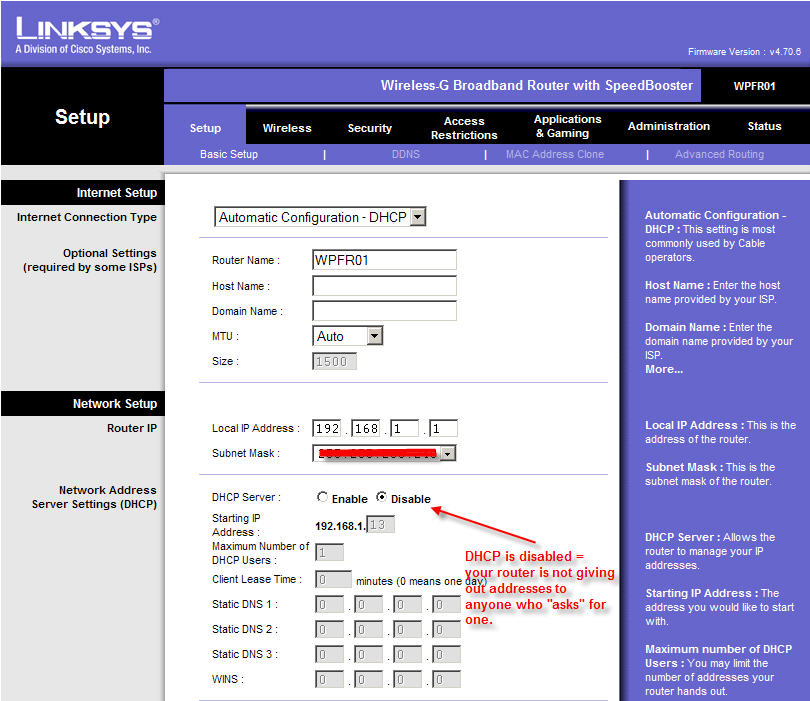
The IP (Internet Protocol) address is the "192.168.1.6" type address that computers use to communicate - often referred to as the "logical" address.  All computers on a network have an IP address if they want to communicate, especially if they want to communicate with your router to get to the Internet.  The IP address can be given to you automatically by what is known as a DHCP server (dynamic), or it can be hard coded (static) address.  If you use a router, by default your router is using its DHCP feature to configure these addresses on your computer for you.  If you are letting your router dish out addresses to your computers, then that means that they are likely to be available to anyone with a computer who can see your wireless network and “ask” for one.  This is simple – just don’t make any available!  Hard code all of your IP addresses into your computers, and tell your router not to make DHCP addresses available.  I set all of the addresses on my computers statically.   But one of the reasons this is a more complicated address to restrict is because using this method requires you to know something about IP addressing, subnet masks, DNS services, and default gateways.  Because of this complexity, many people do not use this method, but I'm a geek, so.....


If you do this also, you can go one step further and make the subnet mask for your network non-standard.  For example, many people at home use the private IP address range of 192.168.1.x.  The default subnet mask for this range is 255.255.255.0.  If you only have a few computers in your network, you can change your subnet mask to something like 255.255.255.240.  That mask will allow you enough address space for fourteen computers.  If you want more addresses, or need fewer addresses, you can adjust the mask you are using.  The added benefit is that even if the attacker hard codes in their own address to fit the range you are using, they have to guess the right mask or they won’t connect.


Encrypt your wireless traffic:

One way that eavesdroppers can find out things like passwords and other things that you would like to keep private is that they can “sniff” the traffic on your network and see it in plain text.  There are a variety of free tools out there, such as Ethereal, that allow people to see network traffic and get information right out of the very packets traveling across the network.  If you encrypt the traffic, however, it comes across as gibberish and they can’t see this information.  There are a couple of popular encryption schemes built in to home and small business wireless devices – WEP, WPA, and WPA2.  WEP, which stands for Wireless Encryption Privacy, is a slightly older and somewhat unsophisticated encryption scheme.  It is static, which means it never changes its encryption keys.  You would have to periodically define new keys or pass-phrases.  WEP is minimal security at best, but again it is better than nothing.  A newer wireless encryption for home users, WPA and WPA2 (Wi-Fi Protected Access) is a more dynamic encryption scheme, and is more secure than WEP.  The keys are dynamically changed during system operation, making it more difficult for someone to sniff your traffic and find out the pass-phrase used.  Not knowing the correct WEP or WPA keys and pass-phrases to enter into their computers makes even connecting to your network more difficult for the attackers as well.


The other thing that needs to be encrypted is your traffic between you and your router/access point management console.  In most home and small business routers, you simply use a web browser to log into and manage your router’s configuration.  The Linksys models (and most others) include the ability to select HTTPS (port 443) traffic between you and your router using an SSL certificate.  This will provide security in that eaves-droppers cannot see your router administrative password in plain text if they are using a program like Wireshark to “sniff” your traffic from afar.  Don’t confuse encryption with blocking access, however.  Anyone who types in the correct address for your router will be offered an SSL certificate, and they can choose to install it.  If they know the password, they can still get in.  What keeps them out is that they don’t have the correct password, and you don’t want to make it easy for them to obtain it.  This type of encryption keeps that password from being sniffed, and makes it more difficult to obtain.


Turn off the SSID broadcast:

The SSID is the network identifier that gets broadcasts by a wireless network access point.  As I mentioned earlier, a default setting for a Linksys access point SSID out of the box is “Linsys.”  You don’t need the SSID broadcast to connect because you can simply type in the SSID when you configure your computer(s).  If configuration gives you a problem, turn on SSID broadcasts, configure your computers, then turn the broadcasts back off.  The exception to this is earlier versions of Windows, such as Windows 98 and Windows XP without Service Pack 2.  Actually, there was a patch awhile back to ensure that Windows XP SP1 would connect without the SSID broadcast, but SP1 is about to become a non-supported product.  You really need SP2 and above (SP3 is the current Windows XP Service Pack Level) to take advantage of the Windows XP security features anyway.  But Windows XP is about to go end-of-life for security support (obsolete), so upgrade if possible.  Get Windows Vista or Windows 7 and you can really take advantage of much better security features.


Disable Wireless Management:

Disabling the ability to manage your router from a wireless connection will help ensure that people sitting out in the street stealing your wireless connection can’t get into your router and change settings.  You will want to have at least one computer that has a wired connection so you can connect to your router and perform configuration changes.  If you only have one computer, and it is a laptop, use the wired connection to connect directly to the router to do maintenance, and the wireless connection to provide your mobility and your normal day-to-day connections.

Additionally, you can ensure that “Remote Access” is turned off.  With remote access, you can come into your router from anywhere else that has an Internet connection.  I have mine turned on because I travel, and sometimes need to come in and make a change while I’m gone, in case the spouse or kids can’t get connected all of a sudden.  But if you don’t need it, the rule of thumb is to just turn it off. 


Other Security Measures:

Securing your wireless access points does not relieve you of the need to use other basic security precautions.  Just because you have a firewall doesn’t mean that a personal firewall program on each computer won’t do you any good.  I have my router locked down pretty well, but my personal firewall still alerts on, and blocks several inbound connection attempts.  Antivirus software, anti-malware software, and keeping your computer up to date with the latest patches are still important requirements. 
You play an important part in security too – if your personal firewall alerts you to something don’t just blindly say “Yes” to the event and move on, hoping for the best.  Question everything!  Just say NO!  You can look at your router’s logs to find suspicious activity so that you will know what further steps to take.  Look at the firewall logs for your personal firewall software also to find out who is trying to attack you, and what methods they are trying to use. 


Wrapping it All Up:

Wireless networking provides an easy and extremely flexible medium for setting up your home or small office network.  But remember:  your network traffic is now traveling through free space, there for the taking for the little WAR drivers and other eaves-droppers.  All kinds of things like passwords, personal data, and even access to the files stored on your computer is at risk.  Even the inexpensive router/access points give you a number of security measures you can implement to help keep you safe.  Nothing is fool-proof.  

This article mentioned some simple measures you can take to increase your chances of being safe and protecting your network.  Be sure to look into the specific configurations that your router/access point allows, and know what you can do with it.  Given enough time and effort, there is nothing that a hacker can’t break into.  But by securing your system you will more likely than not discourage a would-be hacker, and they will just move on to the other six networks on your block.  Don’t be a target – protect your computers, your network, and your data.


For more information, see: